


Key takeaways
- Intimate wash is built around a narrow acidic pH band. Most other formulation decisions follow from it.
- Mildness comes from the surfactant system as a whole, not from one headline ingredient.
- A low pH reduces microbial risk. It does not remove the need for preservative efficacy testing.
- Stability, challenge testing, skin compatibility and pack compatibility should be agreed in writing before bulk production.
Why intimate wash is not a diluted body wash
Body wash and intimate wash are often treated as the same formula at different fragrance levels. They are not. The skin in the intimate area is thinner, carries less sebum and sits in a more acidic environment than the rest of the body. A formula built for the forearm will usually be too alkaline, too heavily fragranced and too aggressive on surfactants for this application.
That is why the specification for an intimate wash starts with three constraints — pH, surfactant load and preservative system — before fragrance, colour or packaging are discussed. Get those three wrong and no amount of added botanicals will fix the result.
pH: the constraint that decides everything else
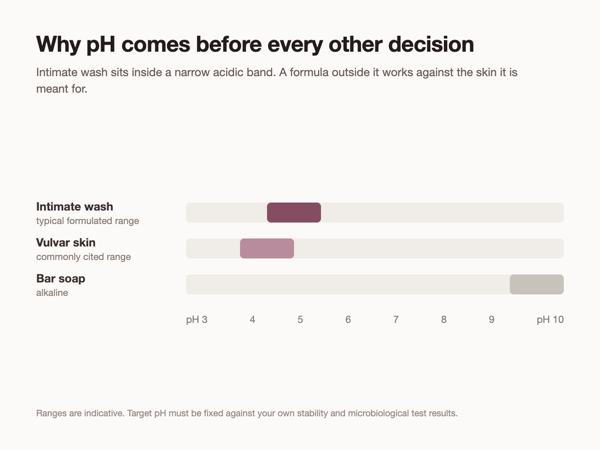
The intimate area maintains an acidic environment as part of its normal defence. A wash that shifts that environment upward, even temporarily, works against the skin it is supposed to care for. This is the single most common reason a private label intimate wash fails consumer testing even when the formula looks reasonable on paper.
Two practical consequences follow.
First, the pH target has to be fixed, not assumed. A typical intimate wash sits in an acidic range close to the skin it is designed for, well below conventional bar soap. The exact target belongs in the product specification, and it should be written as a range with a tolerance, not a single number.
Second, pH has to hold over the shelf life. A formula can read correctly on the day it is made and drift during storage as the buffer is consumed, the preservative degrades or the pack interacts with the contents. This is why pH is verified in the stability study, not only at batch release. Lactic acid is commonly used both to set the target and to provide some buffering, but the buffer capacity has to be matched to the rest of the system.
Choosing the surfactant system
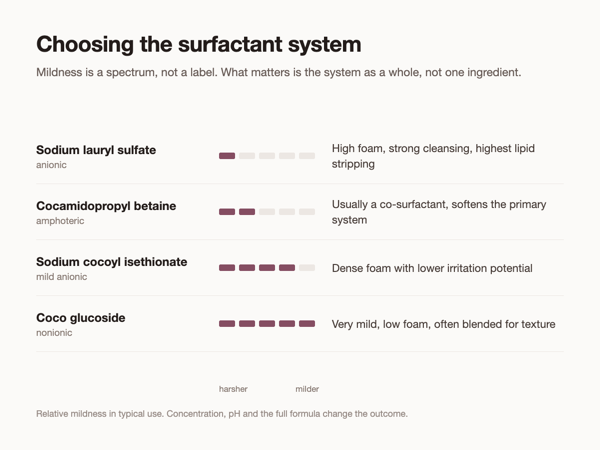
Consumers judge mildness by how the product feels afterwards; formulators judge it by how much of the skin barrier the surfactant removes during use. Those two measures do not always point the same way, which is why the surfactant system is designed as a blend rather than chosen as a single ingredient.
In practice, three design patterns are common.
- Syndet systems built on isethionates give dense foam with a lower irritation profile than traditional soap bases, and they hold up well at acidic pH.
- Blends with an amphoteric co-surfactant such as cocamidopropyl betaine soften the primary surfactant and improve foam quality. The betaine is rarely the cleansing workhorse; it is the modifier.
- Nonionic glucoside systems are the mildest option but produce less foam. They are often blended with a mild anionic to reach a texture consumers expect.
The trap is judging a formula by its ingredient list. A product containing a gentle surfactant can still be harsh if the total active matter is high, the pH is wrong or the system lacks any refatting component. Ask for the total surfactant concentration and the pH, not just the INCI panel.
Preservatives in a low-pH system
There is a widely repeated claim that an acidic formula is self-preserving. It is only partly true. Low pH suppresses the growth of many organisms, but it does not eliminate all of them, and it does nothing about contamination introduced during use. A product that leaves the factory clean can still fail in the consumer’s bathroom.
Two things matter here.
Preservative choice has to be compatible with the pH target. Several common preservatives are only effective within specific pH windows, so a system chosen for a neutral body wash may underperform at an acidic intimate wash pH. This is decided together with the pH target, not afterwards.
Efficacy has to be demonstrated, not assumed. The standard route is a preservative efficacy test against recognised pharmacopoeial or ISO methodology. A pass at the formulation stage is worth considerably more than a supplier’s assurance.
Packaging belongs in the same conversation. Airless pumps and tubes reduce the air and finger contact that drive in-use contamination, which changes the preservative burden the formula has to carry.
What to put in the brief
A brief that produces comparable quotes from different manufacturers needs more than a fragrance direction and a bottle size. At minimum it should state:
- Target pH range and the tolerance you will accept
- Surfactant system preference, or the mildness requirement if you have no preference
- Preservative strategy and whether a challenge test is required
- Product format — wash, mousse, wipes — since this changes the preservative and pack approach
- Claims you intend to make, because they determine which testing is required
- Target market, because regulatory requirements differ by region
See our intimate hygiene manufacturing range for the formats we produce, including an intimate cleansing mousse and intimate care wipes.
Four tests to request before you approve a batch
Formulation is only half of the work. These four results decide whether the product survives the shelf and the skin.
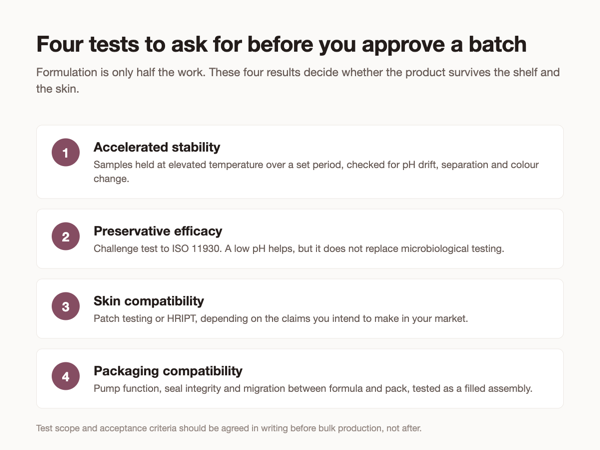
Accelerated stability. Samples held at elevated temperature over a defined period, checked for pH drift, separation, viscosity change and colour shift. Ask for the duration and the acceptance criteria, not just a pass notice.
Preservative efficacy. A challenge test showing the system recovers after inoculation. This is the test most often skipped in cheap quotes.
Skin compatibility. Patch testing, or a fuller human repeat insult patch test if you intend to make claims that require it.
Packaging compatibility. Pump function, seal integrity and migration between formula and pack, tested as a filled assembly rather than as separate components.
Frequently asked questions
Can an intimate wash be fragrance-free?
Yes, and for sensitive-skin positioning it often should be. Fragrance is a common source of irritation in this category. If fragrance is used, the allergen declaration requirements in your target market apply and should be checked before the formula is locked.
Is a lower pH always better?
No. Lower is not automatically better — the target should match the intended use and be supported by stability and microbiological data. Overshooting below the skin’s natural range can cause its own discomfort and may destabilise the preservative system.
Does a gentle surfactant guarantee a gentle product?
No. Total surfactant concentration, pH, the presence of refatting agents and the preservative system all affect the final experience. A mild surfactant used at a high active level can still be harsh.
What changes between a wash and a mousse?
Mainly the surfactant system, the viscosity target and the pack. A mousse needs a foam structure that holds after dispensing, which usually means a different surfactant blend and a valve or pump matched to the formula.
Next step
If you are specifying a private label intimate wash, the fastest way to get a usable quote is to send a brief that fixes pH, surfactant approach, format and target market up front. Our team can review the brief against the formats we produce and tell you which tests will be needed for your claims and market.
View intimate hygiene manufacturing capabilities or send your specification for review.