


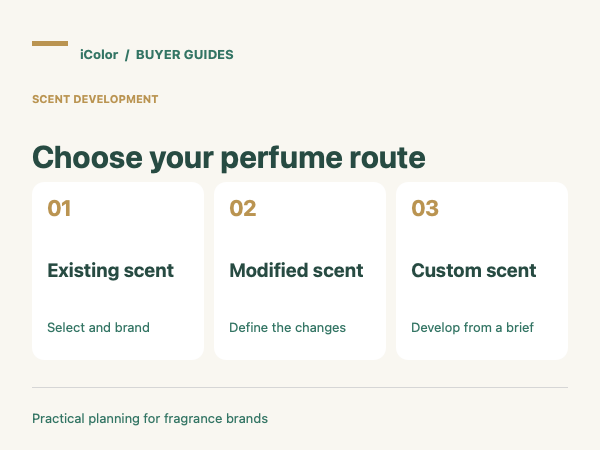
A brand preparing its first fragrance has two decisions to make: how much of the scent to develop, and how much of the packaging to customize. Those decisions do not have to follow the same path. An existing fragrance can go into distinctive packaging; a newly developed scent can use a stock bottle.
When comparing private label vs custom perfume, start with what needs to be different about your product. A recognizable bottle, a particular dry-down and an exclusive formula are separate requirements. Each belongs in the brief and quotation.
This guide compares three practical development routes. It also gives you questions to ask before paying for samples or committing to production.
What Do Private Label and Custom Perfume Mean?
Suppliers use these terms differently. In this guide, private label perfume means selecting an existing fragrance and selling the finished product under your brand, with agreed packaging and labeling. Custom perfume means commissioning fragrance development against a specific brief.
Between those routes sits modification: adjusting an existing fragrance rather than starting a new development. Ask the supplier what will actually change. A new label, a change in concentration and a new formula are very different scopes of work.
White label often refers to a ready-developed product offered to multiple brands. OEM and ODM describe supplier arrangements, but the labels alone tell you little about exclusivity, formula access or production rights. Record those details separately.
Compare the Development Routes
| Decision | Existing fragrance | Modified fragrance | New fragrance development |
|---|---|---|---|
| Starting point | A supplier’s available scent | An available scent with agreed changes | A written fragrance brief |
| Main work | Selection and finished-product approval | Defined scent adjustments and evaluation | Formula development and sample evaluation |
| Useful when | You want to validate a product concept | You like a base scent but need a specific change | The scent itself is central to your positioning |
| Packaging | Stock or customized, subject to component availability | Stock or customized | Stock or customized |
| Rights to confirm | Whether other brands can buy the scent | Whether the adjusted version is exclusive | Formula ownership, exclusivity and access |
| Quote requirements | Scent, concentration, pack and order quantity | The same, plus the modification scope | The same, plus the development agreement |
There is no universal MOQ or delivery time for any column. The formula, bottle, cap, decoration and carton can have different minimum quantities. Ask which component determines the minimum for the finished product.
Choose What You Need to Validate First
For a first fragrance launch
If you still need evidence that customers want your concept, keeping some specifications standard can make the project easier to evaluate. Request an existing fragrance in suitable stock packaging, then compare the total commitment with a more customized option.
A useful brief might say: “We need one 50 ml fragrance for an online launch. Our first priority is an approved scent and dependable spray performance. Please quote a stock bottle with our label, and list any separate development charges.” This is a hypothetical brief, not an iColor customer case.
For an established brand adding a fragrance
Begin with the connection to your existing range. You may need a fragrance that fits a body-care collection, a specific presentation on shelf, or packaging that works with your current fulfillment operation. Identify which of those requirements is essential before selecting a manufacturing route.
Ask the supplier to quote the important change explicitly. “More premium” is difficult to approve. A named bottle finish, a defined cap material or a documented change to the scent gives both sides something to evaluate.
For a brand built around a particular scent
A detailed development brief is more useful than a long list of fragrance notes. Explain the opening, the character you want after application and the qualities you want to avoid. Include reference products as evaluation aids, with notes explaining what you like about each.
Agree how revisions will be handled. Confirm whether development fees cover a fixed number of submissions, what happens if the brief changes and whether the final scent can be used outside this supplier relationship.
Treat Packaging as Its Own Workstream
Decide whether your bottle requires a new glass shape or whether existing glass with decoration will meet the brief. Decoration may include a label or another supplier-supported finish, but availability and minimum quantities need confirmation.
A custom fragrance does not require a private bottle mold. Likewise, a stock scent does not prevent a distinctive packaging design. Ask for separate pricing for the liquid, packaging components, decoration and any tooling.
Before commissioning tooling, read our guide to custom perfume bottle MOQ and mold costs. Use the guide to prepare questions; your project quotation should govern the actual quantities and fees.
Confirm Ownership and Exclusivity in Writing
Paying for development does not tell you what rights you receive. Have the agreement specify whether exclusivity applies to the formula, a particular version, a region, a sales channel or a period of time.
Also clarify who holds the formula record, whether you can obtain the information needed for the intended market and what happens if you change manufacturers. Packaging artwork, bottle tooling and fragrance formulas may have different owners and terms.
Request written answers to these questions before production:
- Can this scent or a substantially similar version be supplied to another brand?
- Which formulation and packaging versions are covered by the agreement?
- Who owns the artwork and any tooling?
- What information and materials remain available after the relationship ends?
Approve the Finished Product, Whatever Route You Choose
Selecting an existing scent still leaves a finished product to approve. Evaluate the proposed liquid in the intended bottle, with its pump and packaging. Record the sample reference and the specifications you accepted.
Documentation should match the actual fragrance mixture and intended use. IFRA explains that its Certificate of Conformity is prepared by the fragrance supplier and does not replace a safety assessment or applicable local requirements. A general “IFRA certified” claim is therefore insufficient as a purchasing specification.
Ask which documents will be supplied, by whom and at what stage. If a formula or concentration changes, confirm whether the documentation must be updated.
Send a Brief That Produces a Comparable Quote
Include your target market, proposed bottle size, quantity per scent, packaging direction and desired launch date. State whether you want an existing fragrance, a modification or development from a new brief.
Ask for two defined options if you are undecided, such as an existing scent with a stock bottle and a modified scent with the same bottle. Keeping the pack constant makes the development difference easier to assess.
iColor describes its business as an OEM/ODM manufacturer covering fragrance development and production. Send iColor your project brief to confirm the available route, sampling scope and current commercial terms.
Frequently Asked Questions
Is private label perfume exclusive to my brand?
Exclusivity is an agreement term. Ask whether it covers the scent, its modified version, packaging or a particular market. Do not infer exclusivity from the words “private label.”
Can I use a stock bottle for a custom perfume?
You can request this combination. The supplier still needs to confirm component availability and suitability for the finished product.
Does OEM mean I own the formula?
The term alone does not establish ownership. Specify formula rights, access and transfer arrangements in the development agreement.
Sources and Scope
This buyer’s guide uses iColor’s published company information and the terminology defined above. It includes no customer case claims or project-specific price promises. Commercial terms require a written quotation.