


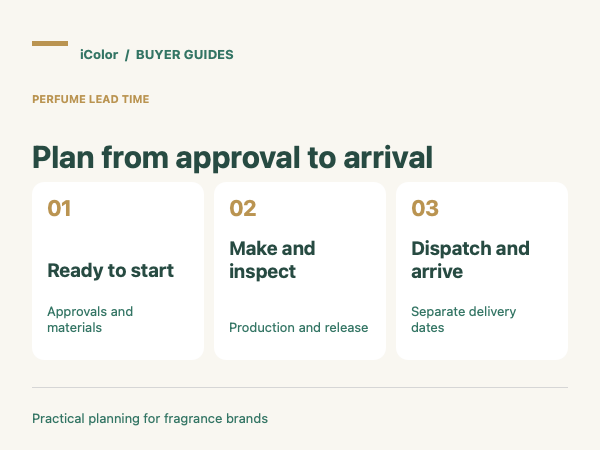
Private label perfume lead time is useful only when its start and finish are defined. “Ready in six weeks” could refer to goods ready for collection, departure from the factory or arrival at your warehouse. Ask the supplier to name the milestone.
An order date alone does not establish that samples, artwork and components are ready. Build the schedule around the remaining work and the approvals that release it. Your project needs a current written estimate against its specification; a general website range is not a delivery commitment.
When does the perfume production clock start?
It starts at the event specified in the supplier’s accepted schedule. Ask for a start condition that both sides can verify, including outstanding approvals, component availability and agreed payment conditions.
For a custom order, separate fragrance development from manufacturing. A new scent may still need evaluation while the bottle artwork is under review. Those tasks should have their own milestones rather than being hidden inside a production number.
The private label vs custom perfume guide helps define the development route. An existing fragrance with available components has a different work plan from a new formula and a newly tooled bottle.
Use precise wording in the order: “Estimated production duration begins after the supplier confirms the listed prerequisites are complete.” List those prerequisites and request the confirmation date. Do not assume sending a deposit means every other requirement is satisfied.
Which milestones belong in a perfume manufacturing timeline?
Track each stage with its prerequisite, owner, forecast date and completion evidence. The schedule should distinguish work in progress from approved work.
| Milestone | Prerequisite to confirm | Completion evidence |
|---|---|---|
| Brief accepted | Defined scent route, quantity, pack and target market | Dated brief and acknowledged exceptions |
| Scent approved | Required sample submissions and feedback | Approved formula/sample reference |
| Pack approved | Bottle, pump, decoration, artwork and carton decisions | Approved component list and artwork versions |
| Materials ready | Procurement and incoming checks completed as agreed | Supplier confirmation of component readiness |
| Production complete | Authorized run and agreed manufacturing controls | Batch/production completion confirmation |
| Quality release | Inspection and applicable reports accepted | Release decision or documented hold |
| Dispatch | Goods released and shipping arrangements complete | Collection/departure confirmation |
| Arrival | Transport and destination handling | Receipt at the named delivery location |
The sampling process guide explains how to record the scent and finished-pack approvals. Keep the two references separate when they are approved at different times.
Can fragrance and packaging work happen at the same time?
Some activities can overlap, but the supplier should confirm which decisions depend on one another. Parallel work is useful only if later changes do not invalidate material already ordered.
A carton layout can be prepared while scent samples are evaluated. Final printing may still depend on the approved bottle dimensions, product information and market review. Ask what can proceed at risk and who bears the cost if the specification changes.
Custom glass adds decisions about drawings, tooling, prototypes and component availability. Use the bottle MOQ and mold cost guide to prepare those questions. Do not assume a mold payment establishes a finished-component delivery date.
Ask the supplier to identify the task that currently determines the earliest completion date. If it is a delayed pump, accelerating fragrance feedback alone will not recover that lost time. Update the schedule after the constraint changes.
How do you work backward from a launch date?
Start from the date stock must be available at the selling location, then work backward through receiving, transport, release, production and remaining approvals. Keep assumptions visible.
Ask the freight provider for the applicable route, departure options, transit estimate and destination handling assumptions. Keep that estimate separate from the factory’s production forecast. Confirm shipment-specific documentation and acceptance requirements rather than assuming every route is available for every perfume.
| Planning field | Entry |
|---|---|
| Launch requirement | Stock available at [location] by [date] |
| Receiving and fulfillment | Owner, duration estimate and holiday constraints |
| Transport and destination handling | Provider estimate, route and booking assumptions |
| Quality release | Inspection date, report turnaround and issue allowance |
| Production | Supplier duration and confirmed start conditions |
| Materials and approvals | Due dates, responsible roles and unresolved items |
| Contingency | Reason for allowance and decision date for using it |
Use a single schedule version. If marketing chooses a launch date before the supplier confirms the work plan, label it a target. A booked campaign should not turn an unresolved production estimate into a confirmed arrival date.
What changes the forecast after an order is placed?
Changes in specification, approvals, materials, capacity, inspection outcomes or transport arrangements can change the forecast. Ask for the affected milestone and the revised dependency, not just a new final date.
Consolidate buyer feedback through one contact. Send an identified sample reference and a complete revision note rather than separate messages from several people. The supplier should confirm which tasks pause while the revision is evaluated.
If an inspection finds a problem, allow for containment, correction and review before release. The perfume quality control checklist helps define the release evidence in advance. A dispatch deadline does not settle an unresolved acceptance decision.
Keep the budget current when a delay produces extra storage, inspection or delivery costs. Use the cost breakdown guide and request written confirmation of any new charges.
ISO 22716 covers cosmetic production, control, storage and shipment within its stated scope. It is not a production-speed benchmark. See ISO 22716 cosmetics GMP overview. Verification of a certification claim is a separate task; ISO guidance on certification and verification explains the role of certification bodies.
What should a useful production status update show?
A useful update shows completed milestones, the current forecast, unresolved issues, the next action and its owner. Ask for evidence appropriate to the milestone rather than treating every progress photo as proof of readiness.
Project and specification version: [reference]
Status date: [date]
Last completed milestone: [item; completion evidence]
Current limiting task: [task; owner]
Buyer decision required: [decision; due date]
Supplier next action: [action; due date]
Forecast production completion: [date; assumptions]
Inspection/release: [date; evidence required]
Estimated dispatch: [date; booking status]
Estimated arrival: [provider estimate; destination]
Changes since last update: [reason; schedule/cost effect]
For repeat orders, reconfirm component availability, artwork, liquid specification and capacity before carrying forward the earlier timetable. A repeat purchase can still depend on replenishing a component.
Send iColor your target arrival date and project brief. Ask for a milestone schedule against the current specification, with the production start conditions and shipping assumptions stated separately. Include these fields in your perfume RFQ.
Frequently asked questions
How long does private label perfume production take?
Request a current estimate for the defined product, quantity and packaging. Ask when the production clock begins and whether the stated period ends at factory readiness, dispatch or arrival. Development, component procurement and transport may have separate schedules that need to be included in your launch plan.
Does production begin as soon as I pay a deposit?
Only if the agreed start conditions are complete. The supplier may also need final sample approval, artwork, components or other prerequisites. Ask for written confirmation of the actual start date and outstanding items. Keep payment milestones and manufacturing readiness visible as separate schedule fields.
Is shipping included in perfume lead time?
That depends on the quotation’s definition. Require separate dates for goods ready, dispatch and estimated arrival at the named destination. Ask the transport provider to state route and handling assumptions. Do not add a factory estimate to a transit estimate without checking the gap between them.
Will changing the carton delay the whole order?
Ask which tasks depend on the revised carton and whether material has already been ordered or printed. Record the new artwork version, approval date and commercial effect. The supplier should update the relevant milestones before you authorize the change rather than promise an unchanged final date without review.
Can I use the previous order’s lead time for a reorder?
Use it as planning context, then request a new confirmation. Components, capacity, specification and transport availability can change. Reconfirm approved references and any remaining packaging stock. The repeat-order schedule should identify its own start conditions and estimated dispatch date.
Sources and scope
iColor Cosmetics | Buyer education | Updated November 19, 2026. The worksheets are editorial purchasing tools. Product-specific methods, commercial terms and release decisions require agreement with the responsible parties. No customer case, individual expert review or completed laboratory test is claimed.