


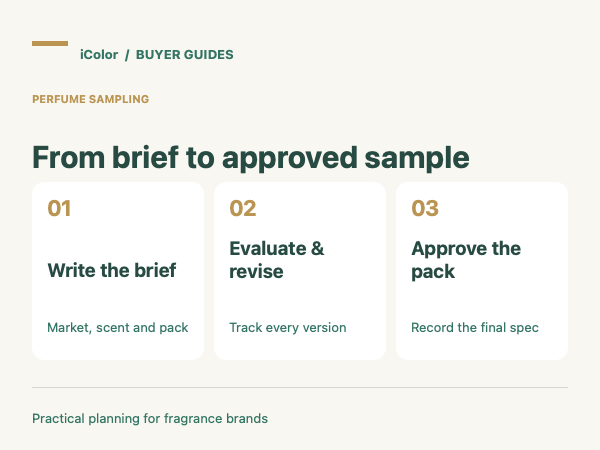
A perfume sample arrives, the team likes it, and someone replies “approved.” Weeks later, the bottle, spray or scent version is still being debated. The approval did not identify exactly what was accepted.
A useful custom perfume sampling process links each decision to a sample reference and a written specification. It separates scent selection from packaging approval, then brings them together in the finished product.
The workflow below is a buyer’s planning checklist. Agree the actual submissions, fees, test plan and timetable with your manufacturer before development begins.
1. Write a Fragrance Brief Before Requesting Samples
Give the supplier enough information to propose a relevant starting point. “A luxury unisex perfume” leaves considerable room for interpretation. Describe the intended customer, where the product will be sold and what you want the fragrance to feel like during use.
You do not need to specify a chemical formula. You do need to distinguish a desired effect from a fixed product requirement. A soft woody dry-down is a scent direction; a 50 ml bottle is a packaging specification.
| Brief field | What to provide |
|---|---|
| Sales market | Countries where the finished product is intended to be sold |
| Customer and use | Who it is for and the intended wearing occasion |
| Scent direction | Opening, main character, dry-down and notes to avoid |
| References | Products you have evaluated and a description of each useful feature |
| Commercial scope | Quantity per scent, target cost basis and desired launch date |
| Packaging | Bottle size, stock or custom format, decoration and carton requirements |
| Approval | Who decides and how feedback will be consolidated |
State which fields are still open. If the order quantity depends on the quotation, ask for defined quantity breaks rather than presenting an uncertain figure as a commitment.
2. Agree What the Sampling Fee Covers
Before paying, request a written sampling scope. Clarify whether the first delivery contains fragrance evaluation samples, packaging components or complete finished units. Ask whether the sample liquid represents the proposed finished concentration.
Confirm the number of initial options and revisions, any extra fees, sample freight and whether a development charge is credited against production. These terms vary by supplier and project. A sample fee does not establish ownership or exclusivity unless the agreement says so.
If you are choosing between an existing scent and a new development, ask the supplier to explain what changes in the sampling scope. Our bottle MOQ and mold cost guide can help you identify a separate packaging-development decision.
3. Identify Every Sample and Evaluate Consistently
Keep the supplier’s reference code on each vial and record the date received. If samples are relabeled for a blind comparison, retain a private key so that feedback can be traced to the correct version.
Use the same evaluation method for comparable samples. Record whether you evaluated on a blotter or in the intended use conditions, the amount applied and when observations were made. Follow the supplier’s instructions for safe evaluation; do not apply unknown concentrates directly to skin.
Separate personal preference from fit to the brief. One evaluator may dislike a floral note while still recognizing that the sample meets the agreed direction. Collect both observations, then have one decision-maker send a consolidated response.
A simple evaluation record
- Sample code and version
- Evaluation method and observation times
- Opening: what fits and what needs changing
- Later character: specific observations
- Fit to the customer and brief
- Decision: retain, revise or reject, with a reason
Keep performance claims separate from informal impressions. A team’s evaluation may guide selection, but it is not evidence for a claim such as “lasts all day” or “suitable for sensitive skin.”
4. Give Revision Notes the Supplier Can Act On
“Make it better” does not define a revision. Name the sample, describe the change and state what should stay. Prioritize requests so that a change in one aspect is not mistaken for a new direction.
For example: “For sample B02, retain the dry woody character. Reduce the sweet impression in the opening. Keep the proposed bottle size and packaging unchanged.” This is an illustrative feedback note, not a customer quotation.
Ask the supplier to assign a new reference when the formulation changes. Evaluate the revision against the previous sample and the original brief. If the team changes the target customer or intended product type, update the brief and confirm the effect on fees and timing.
When two internal reviewers disagree, resolve that disagreement before sending instructions. Conflicting revision requests can lead to another submission without moving the project closer to approval.
5. Evaluate the Finished Pack Separately
A fragrance vial does not approve the production bottle. Request a representative finished unit or agree what a pre-production sample must demonstrate.
Record the bottle and pump references, cap fit, fill specification, decoration, label artwork and carton. Check the visible and functional details against the agreed specification. Define who performs compatibility, stability, leakage and transport testing, and what evidence will be provided.
A buyer’s visual check cannot replace the technical test plan. Ask the manufacturer to explain whether the actual formula, concentration and packaging combination is covered. If a component is substituted later, confirm what needs to be checked again.
| Approval area | Record to retain |
|---|---|
| Fragrance | Approved sample code, formula version and agreed concentration |
| Primary packaging | Bottle, pump, collar and cap references |
| Artwork | Final file version, dimensions, colors and placement |
| Finished unit | Approved sample photographs and retained reference sample |
| Testing | Agreed plan, responsible party and acceptance criteria |
| Documentation | Required documents and their delivery stage |
6. Request Documents That Match the Product
Ask what ingredient, safety and handling information is available for your intended market and product. Match the document reference to the approved fragrance mixture and version.
IFRA explains that a Certificate of Conformity relates to a fragrance mixture and its specified intended use. The supplier prepares it; IFRA does not issue it. The certificate does not replace a safety assessment or applicable national requirements.
Accordingly, keep scent approval and documentation review as separate decisions. Smelling acceptable is not the same as having the required product information. Have the responsible parties agree which reviews must be complete before production or market placement.
7. Issue a Written Approval With Clear Limits
Your approval should identify exactly what can proceed. If the fragrance is accepted but carton artwork remains open, record a fragrance-only approval rather than approving the whole project.
A practical approval record can read:
Approved scope: fragrance sample [reference], version [number], for [product and agreed concentration]. Packaging approval: [references or pending]. Outstanding items: [list]. Changes after this approval require written confirmation before production.
The bracketed fields are a template for the buyer to complete. Agree the final record with the supplier and keep a reference sample under the agreed storage conditions. This gives both sides a common basis for discussing later production questions.
Prepare Your Sampling Request
Send one brief with the target market, scent direction, proposed format, quantity and packaging requirements. Ask for the sampling scope and current terms before payment.
Contact iColor with your fragrance brief to discuss the available development route. Include any fixed launch date so that sampling, approval and production can be discussed together.
Frequently Asked Questions
How many perfume sample revisions should I expect?
Agree the included submissions and revision policy in the quotation. The number depends on the brief and commercial arrangement; this guide does not promise a fixed allowance.
Can I approve a fragrance from a blotter alone?
A blotter can help select a scent direction. Define the remaining finished-product evaluation and technical checks before approving production.
What if the packaging changes after approval?
Record the change and ask which evaluations, documents and approvals must be repeated. Do not assume the earlier acceptance covers a different component.
Sources and Scope
This article provides an editorial procurement workflow, not a record of iColor’s internal operating procedure. The sample record and feedback note are illustrative. Project-specific steps require agreement with the manufacturer.