


Two suppliers quote the same quantity of 50 ml perfume. One includes a decorated bottle and retail carton. The other includes the filled bottle only. Comparing their unit prices would produce a misleading budget.
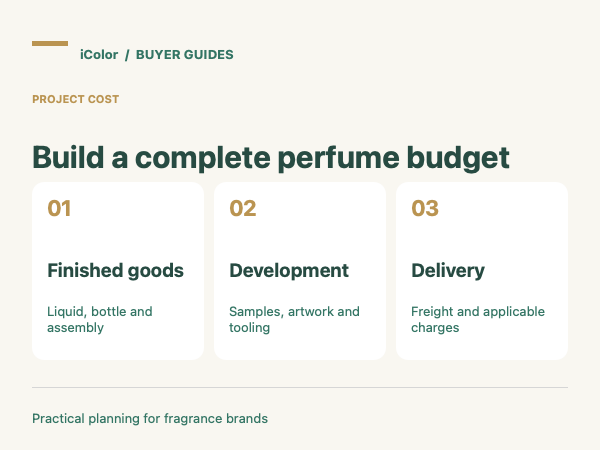
Private label perfume cost becomes useful when the quotation defines the product and the charges around it. Separate the recurring cost of finished goods from one-time development charges, then account for delivery and other costs outside the factory quotation.
This guide provides a cost worksheet and a worked arithmetic example. It does not present a market price range or an iColor quotation. Your actual price depends on the approved specification and current written terms.
Define the Product Before Asking for a Unit Price
Give each supplier the same purchasing brief. State the finished volume, quantity per scent, fragrance-development route, bottle, closure, decoration and retail packaging. Include the destination and requested delivery basis.
A quote for “1,000 perfumes” leaves important questions open. Is that one scent or several? Is the bottle a stock component? Does the price include the pump, cap, label and carton? Are samples, tests and freight charged separately?
Ask for the specification reference and quotation validity period. If you revise the pack after receiving prices, request an updated quote rather than comparing the old figure with a new product.
What Makes Up the Recurring Unit Cost?
| Cost line | What to confirm | Why it affects comparison |
|---|---|---|
| Finished fragrance liquid | Approved formula, concentration and fill volume | Different liquid specifications describe different products |
| Bottle | Component reference, capacity, glass specification and finish | A similar appearance does not establish an identical component |
| Pump, collar and cap | Included components, references and assembly | Closures may be excluded from a bottle-only price |
| Decoration | Method, artwork, colors and placement | Setup and recurring decoration charges may be separate |
| Retail packaging | Carton, insert, label and other included materials | Gift packaging and basic cartons have different specifications |
| Filling and assembly | Operations covered by the quoted price | Confirm whether the quote is for components or finished units |
| Inspection and packing | Routine checks, master cartons and any separately priced services | Extra testing or inspection may sit outside the unit price |
Ask the supplier to identify inclusions even if it provides a single bundled price. You need enough detail to understand what will arrive and to compare later revisions.
Separate One-Time Charges From Production
Development fees can include fragrance work, packaging design, artwork setup, tooling or prototypes. Request a separate list stating which charges recur on repeat orders and which are credited when production proceeds.
For custom glass, confirm mold ownership, maintenance arrangements and the minimum order attached to the tooling. A paid mold does not establish unrestricted ownership unless the agreement grants it. Our custom perfume bottle MOQ and mold cost guide explains the questions to raise before commissioning a new shape.
If you want to compare an existing scent with a new formulation, hold the packaging specification constant. Then ask for the development fee and recurring price for each route. This makes the extra commitment visible.
How MOQ Changes the Budget
Ask for MOQ by scent and by packaging component. The finished-product minimum may depend on a bottle decoration run or a printed carton rather than the liquid alone.
Also confirm whether the quoted quantity is what you buy, what is produced or what is expected to be shipped. If unused components remain after a run, ask who owns them, where they will be stored and whether storage or later assembly is charged.
A lower unit price at a higher quantity creates a larger purchase commitment. Compare total cash required, stock you can reasonably sell and the conditions of the next order. Avoid choosing a quantity solely to obtain a lower displayed unit price.
Calculate the Project Cost on a Consistent Basis
For internal planning, use these relationships:
- Finished-goods subtotal = ordered units × quoted finished-unit price.
- Project purchase cost = finished-goods subtotal + development and other separately quoted charges.
- Estimated landed cost = project purchase cost + delivery, insurance, import and local handling costs that apply to the shipment.
Avoid counting the same item twice. For example, freight already included in the supplier’s price should not be added again. Ask a freight or import service provider to confirm shipment-specific charges rather than treating a general estimate as a customs calculation.
Worked example: arithmetic only
The following figures are invented to demonstrate the calculation. They are not a quotation, price benchmark or forecast of iColor’s charges.
| Illustrative item | Calculation | Amount |
|---|---|---|
| Finished goods | 1,000 units × $6.00 | $6,000 |
| One-time development and setup | Assumed fixed amount | $500 |
| Freight and handling allowance | Assumed planning amount | $900 |
| Subtotal before any other applicable charges | $6,000 + $500 + $900 | $7,400 |
| Allocated subtotal per ordered unit | $7,400 ÷ 1,000 | $7.40 |
This example excludes any tax, duty or other cost not shown. It therefore does not calculate a complete landed cost. It shows why a $6.00 factory unit price and a $7.40 allocated project subtotal can both describe the same hypothetical order.
For a repeat order, remove a one-time charge only after the supplier confirms it will not recur. Recheck component prices, freight and quote validity for each order.
Compare Quotes With This Worksheet
Copy these fields into your purchasing sheet and require an answer for each supplier:
- Quote date, currency, validity and payment milestones
- Quantity per scent and minimums for each custom component
- Approved liquid, fill volume and packaging references
- Finished-unit price and included operations
- Sample, development, artwork and tooling charges
- Testing, inspection and document charges, if separate
- Delivery basis, destination and freight inclusions
- Production timing and the event that starts it
- Rules for component substitutions and specification changes
- Terms for shortages, defects and unused packaging
A blank field is a question to resolve before comparing the final totals. Keep a written record of clarifications alongside the quotation.
Reduce Cost by Changing a Defined Specification
Ask for alternatives with a clear tradeoff: an existing bottle instead of private tooling, a different decoration method, or a simpler carton. Request revised samples or artwork where the change affects what you will approve.
Hold critical requirements steady while evaluating options. If the pump, formula or bottle changes, ask whether the agreed compatibility and performance checks still cover the revised product.
Keep the document scope visible too. IFRA states that a Certificate of Conformity does not replace a safety assessment or local requirements. Agree which parties handle the necessary product review and what the quotation includes, rather than treating a generic certification phrase as a complete service.
Request a Quote You Can Use
Send your target market, quantity per scent, proposed volume, fragrance direction and packaging requirements. Mark the items that are flexible and ask for separate prices for meaningful alternatives.
Request a project quotation from iColor. Ask for the finished-product scope, separate development charges and delivery exclusions in writing so you can build your budget on the same basis.
Frequently Asked Questions
What does private label perfume cost per bottle?
A useful price requires a defined formula, volume, packaging, quantity and delivery basis. This guide deliberately avoids an unsupported universal price range.
Are samples and development included in the production price?
They may be separate, included or credited under agreed conditions. Ask the supplier to state the arrangement in the quotation.
Does a lower MOQ mean a lower total launch cost?
It can reduce the initial inventory commitment, but development, packaging and delivery charges still need to be included. Compare complete project totals for the same specification.
Sources and Scope
The worksheet is editorial purchasing guidance. The worked numbers are hypothetical. This article makes no promise about iColor pricing, margins or delivery terms.